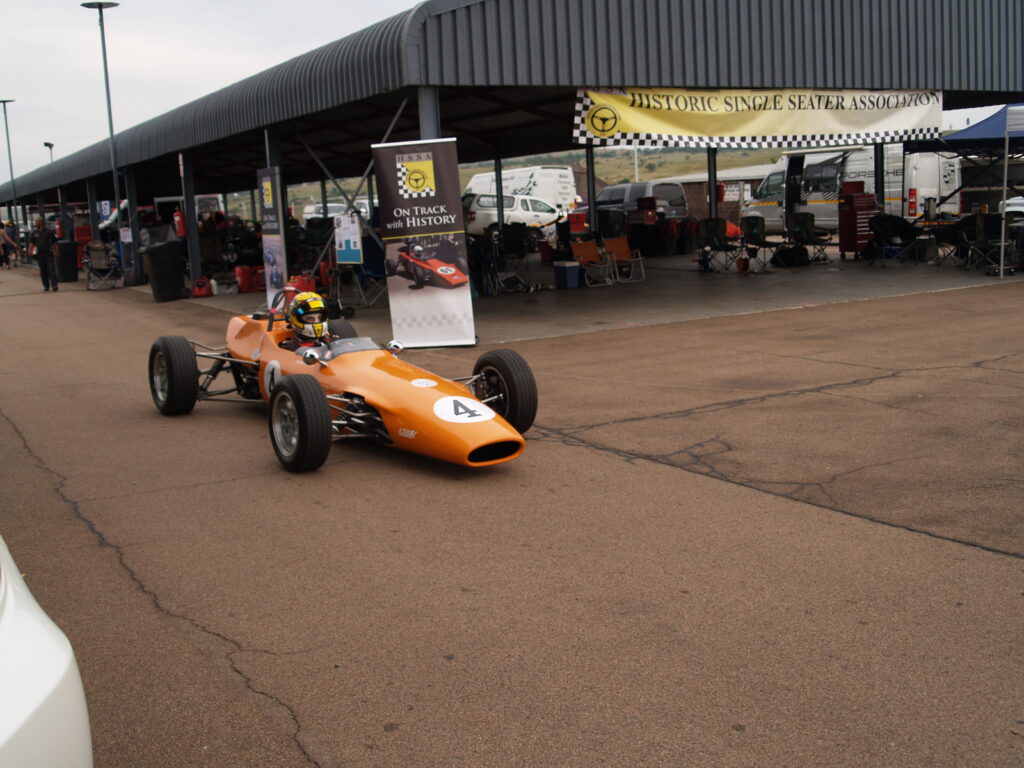
The origins of the Historic Single Seater Association (HSSA) date back to the early 1980s, catering to all single-seat historic racing cars built before 1977. The association also welcomes purpose-built two-seat race cars from the same period.
Interest in historic racing cars grew rapidly in the early ’80s, fuelled by the legacy of South Africa’s renowned post-war racing specials and inspired by the European historic racing scene. The rising value of ‘obsolete’ race cars further contributed to this enthusiasm. Some of the first historic cars to hit the grid included Dunkerley’s Chevron B8, Dave Sinclair’s Formula Ford, Weber’s Lotus 31, and Ron Korte’s Lola. Soon after, Richard Baker’s Cooper Jap, Smirt’s Barracuda, and Daggit’s Taraschi joined the line-up. By 1985, even more significant cars had made their way to the track, including David Cohen’s GT40, du Plessis’ LDS Alfa, a Lola T70, a Chevron B21, and the Riley Special.
Challenges and Growth
Initially, these historic single-seaters raced alongside classic saloons in a club championship. However, this led to frequent close calls—and some dramatic incidents. A turning point came at Midvaal when Brian Evans’ Mustang collided with the LDS Alfa, resulting in a total write-off of the Mustang and tyre marks on the LDS driver’s helmet! In response, Motorsport South Africa (MSA) immediately banned mixed-field races.
This decision left single-seater racers with nowhere to compete for several years. However, in September 1998, a breakthrough came when they were offered a race at Kyalami as part of the Vodacom Series, with six cars on the grid. The following year saw three dedicated races, and despite various challenges, perseverance paid off. By 2001, there were 26 entries at Zwartkops—though only 12 managed to start the race!.
Establishing an Independent Championship
In 2005, Pat Dunseith and Howard Robinson established a low-profile championship, with four events that attracted 16 cars to the Zwartkops race. For the first time, East London was included in the calendar, becoming a focal point of the season and the home of the HSSA’s Annual General Meeting for the following five years.
Until 2005, single-seaters were part of the Historic Racing Car Register (HRCR). However, after much discussion—and some encouragement from Dickon Daggit—the HSSA became semi-independent. By 2008, following financial discussions with HRCR, it was proposed that the HSSA become fully independent, while still maintaining a branch membership with the Sports Car Club (SCC). This move was formally approved at the AGM on the 29th of November.
Preserving Racing History
Thanks to the generosity of many enthusiasts, the late Howard Robinson and current historian Ian Hebblethwaite have compiled extensive records on HSSA cars. Today, the association boasts a dedicated library that documents the history of many of the vehicles and races.
HSSA prides itself on being one of the purest forms of historic racing—though not without its challenges. Due to the rising costs of racing, the championship now consists of only four races per year, held at Zwartkops . However, this format may evolve in the future.